 Saudi Arabia
 United Arab Emirates
 Qatar
 Kuwait
 Oman
 Bahrain
 Jordan
 Iraq
 Lebanon
 Syria
 Palestine
 Egypt
 Sudan
 Yemen
 Morocco
 Algeria
 Tunisia
 Libya
 Mauritania
 Somalia
 Djibouti
 Comoros
Sudan take-home pay and income tax calculator 2026
Enter your gross salary to see what reaches your bank account after income tax and social insurance, under the 2026 rules of the Sudan Taxation Chamber.
For an expat in Sudan, a monthly salary of 500,000 Sudanese pounds leaves 417,500 Sudanese pounds take-home after 82,500 income tax (SDG), or 16.5% of gross pay.
- We exempted 300,000 pounds a year (5% of the total salary) as transport, representation and cost-of-living allowances, under Administrative Decision No. 5 of 2022. If your salary does not include these allowances, untick this option.
Salary after tax in Sudan
Monthly take-home pay for common salaries, in Sudanese pound (SDG).
| Gross per month | Net, expat | Net, national | National deduction |
|---|---|---|---|
| 100,000 SDG | 93,250 | 86,450 | 13.6% |
| 200,000 SDG | 174,500 | 161,700 | 19.2% |
| 300,000 SDG | 255,500 | 236,300 | 21.2% |
| 500,000 SDG | 417,500 | 385,500 | 22.9% |
| 750,000 SDG | 620,000 | 572,000 | 23.7% |
| 1,000,000 SDG | 822,500 | 758,500 | 24.2% |
| 1,500,000 SDG | 1,227,500 | 1,131,500 | 24.6% |
| 2,500,000 SDG | 2,037,500 | 1,877,500 | 24.9% |
Calculated with 2026 rules for a single, full-time employee whose salary is their only income.
Income tax rates in Sudan 2026
| Annual taxable income (SDG) | Rate |
|---|---|
| 0 to 360,000 | 0% |
| 360,000 to 600,000 | 5% |
| 600,000 to 840,000 | 10% |
| 840,000 to 1,200,000 | 15% |
| Over 1,200,000 | 20% |
Annual brackets under Council of Ministers Order No. 457 of 2022. The monthly equivalent: 30,000 pounds exempt, then 20,000 at 5%, then 20,000 at 10%, then 30,000 at 15%, and anything above 100,000 pounds a month at 20%. The brackets apply to income after the social insurance contribution is deducted. A non-resident does not get the exempt band.
Personal income tax exemptions in Sudan
What is left out of taxable income for personal income tax on salaries, under the Income Tax Act 1986, its amendments and the decisions that implement it.
| The first 30,000 SDG a month (360,000 a year) | Exempt for residents; not available to non-residents |
| Pension, social insurance and post-service fund contributions | Deducted before tax is worked out (Article 28) |
| End-of-service pay | Exempt |
| Transport, representation, hospitality and cost-of-living allowances | Exempt up to 5% of total monthly salary (Administrative Decision No. 5 of 2022) |
| Domestic travel allowance | 75% exempt, up to 10,000 SDG a month |
| Foreign travel allowance | Exempt within Council of Ministers rates |
| Medical services paid by the employer | Not part of taxable income |
| Commuted part of a pension, pay in lieu of notice, and injury or dismissal compensation | Exempt |
| Diplomats, consuls and staff of some international organisations | Exempt under the Immunities and Privileges Act 1956 |
| Age exemptions (age 50 or 25 years of service) | Abolished by the 2022 amendment; all public and private-sector workers are now taxed |
| Board members' fees | Taxed at the top rate with no exemption |
| Incentives, grants and commissions | Final tax of 5% withheld at source |
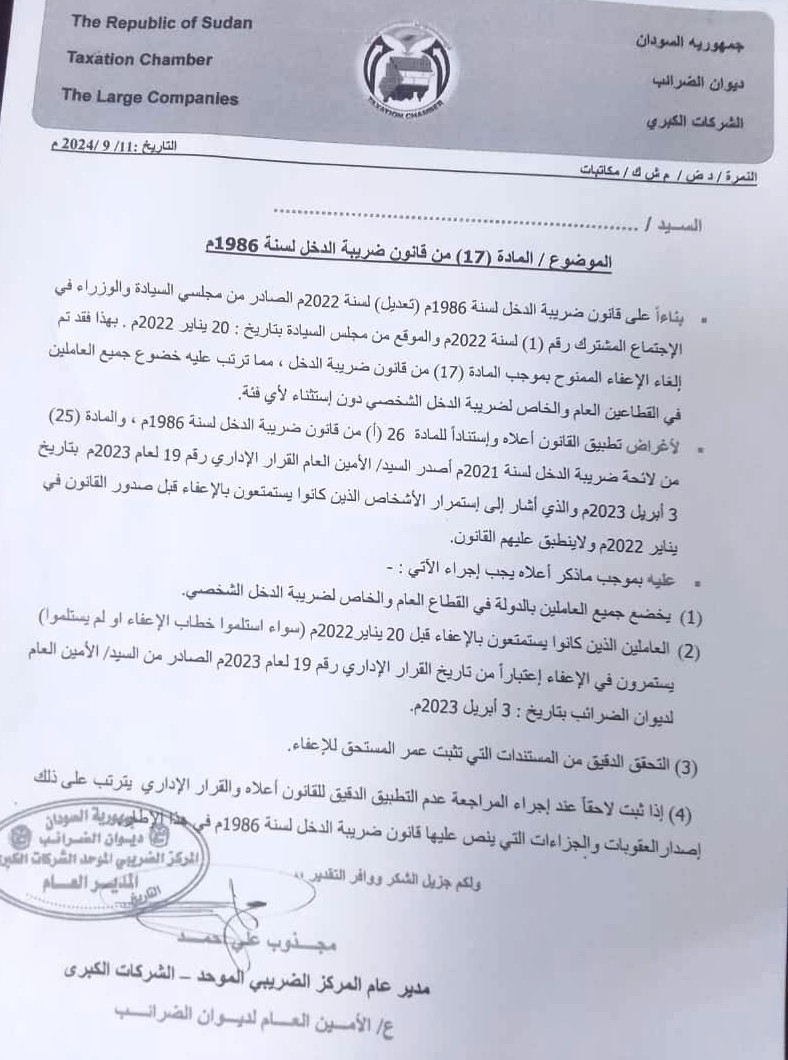
Sources: Income Tax Act 1986, Articles 26 and 28 and the First Schedule (Taxation Chamber) · Taxation Chamber: all workers taxed since the 2022 amendment (11 September 2024) · Comprehensive reference on tax and zakat in Sudan 2026 (secondary source)
Worked example
An expat employee earning 500,000 Sudanese pounds a month, 6,000,000 a year:
- Personal income tax: 990,000 SDG a year (82,500 a month).
- Take-home pay = 6,000,000 minus 990,000 = 5,010,000 SDG a year, or 417,500 a month.
- We exempted 300,000 pounds a year (5% of the total salary) as transport, representation and cost-of-living allowances, under Administrative Decision No. 5 of 2022. If your salary does not include these allowances, untick this option.
- We did not deduct social insurance because the Act defines an insured worker as a Sudanese person.
Key tax facts about Sudan
- Tax year
- Assessment year 2026; salaries are taxed on a calendar-year basis
- How tax is collected
- The employer withholds tax at source every month and pays it to the Taxation Chamber with a monthly return
- Tax-free band
- 30,000 SDG a month or 360,000 SDG a year; not available to non-residents
- Top rate
- 20% on taxable income above 100,000 SDG a month
- Social insurance
- 25% of monthly pay: 17% from the employer and 8% from the worker (Social Insurance Act 1990)
- Insurance deducted before tax
- Yes, Article 28 of the Income Tax Act deducts pension and insurance contributions before tax is worked out
- Employee exemptions
- The 2022 amendment ended earlier exemptions for some groups of workers; all public and private-sector employees are now taxed
- VAT
- 17% standard rate, according to the Sudan tax guide 2026
- End-of-service pay
- Exempt from personal income tax under Article 28 of the Act
Tax guide to Sudan Living in Sudan in figures Tax authority and filing deadline
Compare Sudan with other countries
Salary questions about Sudan
What is the take-home pay on 500,000 Sudanese pounds in Sudan in 2026?
For an expat in Sudan, a monthly salary of 500,000 Sudanese pounds leaves 417,500 Sudanese pounds take-home after 82,500 income tax (SDG), or 16.5% of gross pay.
Is take-home pay different for nationals and expats in Sudan?
Yes. For a national in Sudan, a monthly salary of 500,000 Sudanese pounds leaves 385,500 Sudanese pounds take-home after 74,500 income tax and 40,000 social insurance (SDG), or 22.9% of gross pay. An expat on the same salary takes home 417,500 Sudanese pounds.
Is there income tax on salaries in Sudan?
Yes. Sudan taxes salaries at 0% to 20%, with a top rate of 20%. It is usually withheld at source by the employer.
How much social insurance do employees pay in Sudan?
8% of the monthly wage for Sudanese workers. Cap: No cap is published in the text of the Act.
How much is deducted from 2,500,000 Sudanese pounds a month in Sudan?
622,500 Sudanese pounds a month (24.9%), leaving 1,877,500 Sudanese pounds. The marginal rate at this salary is 20%, so that share of any raise goes in tax.
Official sources
Every figure in this calculator comes from these sources, last checked on 9 October 2026. The brackets are confirmed by the Taxation Chamber and Council of Ministers documents themselves, but we found no decision more recent than 2022, nor anything ruling one out, and the war has stopped many official websites from being updated. The social insurance rates come from the text of the Act as reproduced on an unofficial legal website; we could not reach the National Social Insurance Fund website. We apply the allowances exemption up to 5% of the total salary (Administrative Decision No. 5 of 2022) as the Comprehensive Reference on Taxes in Sudan 2026 does in all its examples, but we did not find the text of the decision itself on the Taxation Chamber website; it can be switched off in the calculator options. We did not apply zakat, and our treatment of non-residents is our own reading, because the circular does not say which rate applies to the first band. The exchange rate used is the commercial banks' average for March 2026; the parallel market rate is much weaker.
- Council of Ministers: order under the (Personal) Income Tax Act, Decision No. 457 of 2022 dated 29 November 2022 (published on the Taxation Chamber website) Official source · checked 2 October 2026
- Taxation Chamber, General Directorate of Personal Income Tax: circular on Decision 457 of 2022 with the annual and monthly brackets (3 April 2023) Official source · checked 2 October 2026
- Taxation Chamber: section 17 of the Income Tax Act 1986 and the taxation of all public and private sector employees (11 September 2024) Official source · checked 2 October 2026
- Income Tax Act 1986 (English text on the Taxation Chamber website), section 28 Official source · checked 2 October 2026
- Sudanese Social Insurance Act 1990, sections 3 and 25 (reproduced text, Mohamah.net) Secondary source used to cross-check · checked 2 October 2026
- Comprehensive Reference on Taxes and Zakat in Sudan 2026, Mamoun Idris, published on the website of the Accounting and Auditing Profession Regulation Council (secondary source) Secondary source used to cross-check · checked 2 October 2026
- Central Bank of Sudan: Economic and Financial Statistics Review, first quarter 2026 Official source · checked 2 October 2026
Results are estimates for information only. Your actual pay can differ with your contract, exemptions and family situation. How we calculate.
Send it to someone who needs it
Share this page in a second, or add the site to your phone so it opens with one tap, like an app.
On iPhone: tap Share in the browser, then "Add to Home Screen".
Bookmark it: Ctrl + D
Follow us on InstagramFacebook
Social insurance rates